AI's Power Isn't in Prompts. It's in Context.
Most consumer AI adoption is still surface-level — better questions to a chat box. The real lift comes from connecting AI to the data, systems, workflows, and decisions where work actually happens. Here's why that gap matters and what comes next.
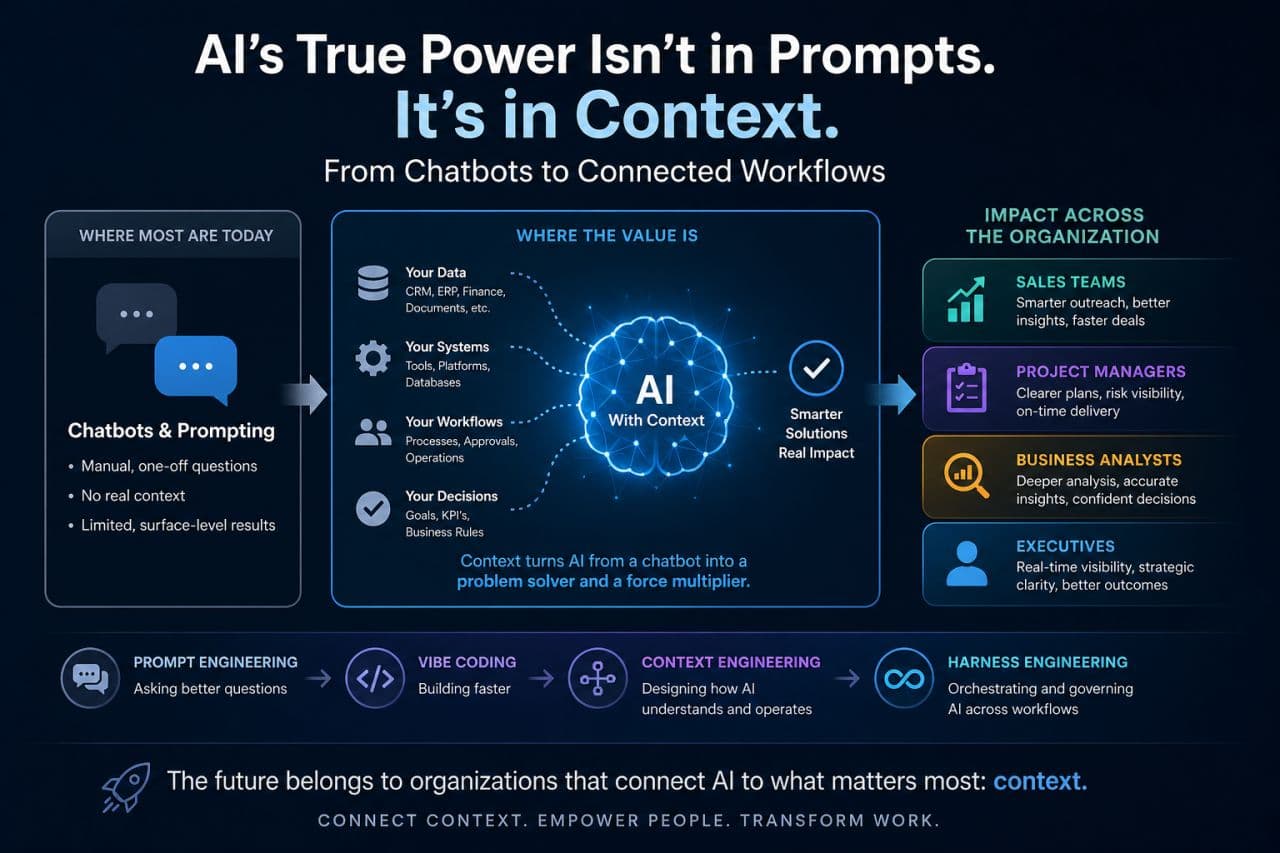
The current wave of consumer AI adoption — across tools like Claude and ChatGPT — is still largely surface-level. Most people use these systems as advanced chat interfaces. They craft a saved prompt, paste it into a text box, copy the answer back into whatever they're working on, and call it a workflow.
It's a useful workflow. It's also a small fraction of what these systems can do.
The real power of modern AI isn't in the prompt. It's in the context — the data, systems, and decisions the model can actually see when it's working on a problem. Without that context, even the best model in the world is reduced to generalized advice. With it, the same model can reason about your domain, your data, and your operating constraints, and produce outputs that are specific enough to act on.
That's the gap most organizations are sitting in right now. AI is present, but it's not operational.
The chat-box ceiling
There's a ceiling to what you can do with a chat interface alone. You can ask better questions. You can paste in more documents. You can build a personal library of prompts. All of that is real value, and none of it is wrong.
But if you've ever found yourself:
- Re-explaining the same project to the model every Monday morning,
- Pasting in the same CSV three different times to ask three related questions,
- Copying an answer out of the chat, editing it, and pasting it into a Jira ticket / Slack message / Notion doc by hand,
- Or quietly wondering whether the model is hallucinating because it doesn't actually know your company's terminology…
…then you've already met that ceiling. It isn't the model's fault. It's a context problem. The system can only reason over what it can see, and a chat window is a narrow window.
Where context actually lives
Look at where the work in any organization actually happens. It doesn't happen inside a chat tab. It happens across:
- Your data — CRM, ERP, finance systems, document stores, analytics warehouses.
- Your systems — the tools and platforms your teams already log into every day.
- Your workflows — the processes, approvals, and operational sequences that turn intent into outcome.
- Your decisions — the goals, KPIs, and business rules that make a "good answer" specifically good for you.
The minute AI is connected to those four surfaces, it stops being a chatbot and starts being a problem solver. The output stops being "here are some general best practices" and starts being "given this account's renewal date, this rep's pipeline coverage, and this margin target, here are the three deals to focus on this week."
Same model. Same prompt. Completely different value, because the context changed.
The adoption gap outside engineering
Engineering teams are starting to feel this shift first, because they're the ones wiring AI into their own systems day-to-day. But the gains are at least as large for the rest of the organization — they're just less visible because the integration work hasn't happened yet.
- Sales teams with AI connected to CRM, call notes, pipeline data, and product knowledge get smarter outreach, sharper insight on at-risk accounts, and faster cycles. Without that context, they get… better email drafts.
- Project managers with AI connected to issue trackers, calendars, and team capacity get clearer plans, earlier risk visibility, and fewer surprises at week eight of a twelve-week roadmap. Without context, they get a slightly faster status report.
- Business analysts with AI connected to data warehouses, BI tools, and historical reporting get deeper analysis, accurate insights, and confident recommendations. Without context, they get plausible-sounding summaries of dashboards the model can't actually see.
- Executives with AI connected to operating data and strategy artifacts get real-time visibility, strategic clarity, and outcomes they can actually steer. Without context, they get summaries of the news.
In every case, the same model produces dramatically different value depending on whether or not the context is connected. And in most organizations today, the context is not connected. Which means the productivity story being told about AI is being told one zoom level above the actual operating reality.
MCP, "apps", "connections": the integration that isn't happening
There's a class of integrations that solves exactly this problem — most often surfaced under names like MCP servers, apps, or connections depending on the tool. They give an AI system live, governed access to the data and systems it needs to do real work: a CRM tool here, a documentation source there, a workflow trigger somewhere else.
This category is genuinely young, but it's not theoretical. The pieces work. The patterns are public. The market for them is growing fast.
And yet, in most organizations, they remain underutilized. Sometimes that's a governance question — "we can't let an LLM see customer records without policy review" — and that's a fair concern that deserves an actual answer. Sometimes it's a cost question. Most often, in my experience, it's simply a lack of awareness that this layer exists at all.
The result is a strange in-between state: AI is available to the workforce, but the workforce is using it as a smarter version of search instead of as an integrated participant in their actual work. The strategic narrative says "we've adopted AI." The day-to-day reality is: chat tab, copy-paste, repeat.
The terminology hasn't caught up
Part of why this gap persists is that the language we use to describe working with AI hasn't caught up with where the value lives.
- Prompt Engineering — the discipline of asking better questions of a chat interface. Real, useful, mostly a beginner's pattern. The ceiling is the chat box.
- Vibe Coding — building faster by riffing with AI assistants. Very real. Mostly an individual-productivity story so far.
Both of these describe the early interaction patterns between a human and an AI system. Neither describes the deeper engineering work that makes AI reliable inside an actual organization. For that, a more accurate framing has been emerging across the industry:
Context Engineering
The discipline of designing the data structures, system boundaries, and information flows that allow AI to function reliably and at scale.
Context Engineering is what happens when you stop treating "what's in the prompt" as a string-formatting exercise and start treating it as an architecture problem. What data does the model see? Where does it come from? Who's allowed to send it there? How is it shaped — verbatim, summarized, indexed, retrieved on demand? What lives in the system prompt, what lives in tool surfaces, what lives in long-term memory, what gets compacted out? How does information cross agent boundaries without losing fidelity?
These are the questions that determine whether an AI system is dependable inside a real business or just impressive inside a demo. They're closer to systems design than to copywriting.
Harness Engineering
A further evolution is already underway, especially in engineering organizations: Harness Engineering — the work of orchestrating and governing how AI operates across interconnected systems and workflows.
Where Context Engineering is about giving an AI system the right inputs, Harness Engineering is about giving it the right operating environment: the runtime that owns the tool surface, manages permissions, handles memory, mediates retries, enforces budgets, and decides what an autonomous agent is and isn't allowed to do on its own. Some teams build their harnesses from scratch. Others use Anthropic's Claude Code, or open-source projects like Archon and OpenClaw, or build their own thin layers on top of the model providers. The specific stack matters less than the recognition that the harness is a first-class engineering surface, not a black box.
The simplest way to think about the layered progression: Prompt Engineering asks better questions. Vibe Coding ships faster. Context Engineering designs how AI understands and operates. Harness Engineering orchestrates and governs how AI operates across workflows. Each layer is real. Each layer compounds the ones below it. Most organizations are still operating at layer one.
Engineering goes first. Then everything else.
Engineering teams are adapting to this shift first because the cost of not adapting is immediately visible — slow shipping, missed regressions, talent leaving for places that ship faster. The next phase is broader organizational adoption, and the pattern is already discernible: it doesn't happen by sending more people to a prompt-engineering workshop. It happens by connecting the systems where work actually lives.
That's a different kind of project. It's data architecture, identity and access, integration plumbing, governance design, change management, and yes, some prompt and tool surface design — but the prompt is the smallest part of the stack, not the largest.
When that work lands, the resulting outputs stop reading like a chatbot's best guess and start reading like the work product of someone who actually has access to the systems your teams use. That's the moment AI moves from a productivity feature to an operating reality.
Where this is heading
The framing matters because it sets the expectation for what "adopting AI" actually means in a serious organization in 2026 and beyond. It is not "we rolled out a chat tool." It is closer to "we connected the systems where our work lives to a class of tooling that can reason over them, and we built the engineering, governance, and operational practice to do that responsibly."
That work doesn't show up in productivity benchmarks the way "saved 30 minutes a day on email drafting" shows up. It shows up in how the organization is structured, how decisions are made, and how outcomes scale.
The future belongs to organizations that connect AI to what matters most: context.
Connect context. Empower people. Transform work.